
A well-curated wardrobe is all about versatility and timeless style. Whether you’re updating your closet or starting fresh.

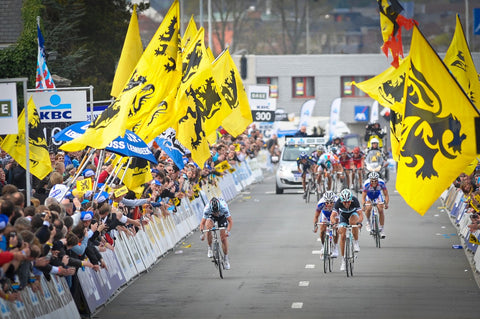
The Tour of Flanders (Ronde van Vlaanderen in Dutch), also known as “De Ronde”, is a true monument of cycling. If you haven’t heard of it, you are definitely in the wrong sport, should not call yourself a cyclist, and perhaps do not deserve to be part of the Belgian Crew.
Scheduled one week ahead of Paris–Roubaix, the event only stopped during World War I (1915-1918). Ronde van Vlaanderen is the cycling race with the record of most consecutive editions, taking place continuously since 1919; it did not stop even during World War II.
 Everything began in 1912 when Odile Defraye became the first Belgian winner of the Tour de France and a Flemish newspaper, Sportwereld (Sport World), was born. While Defraye’s victory added impetus to the already flourishing cycling scene in Belgium, the subsequent appearance of Sportwereld in September 1912 would have a more significant effect.
The directors Leon Van de Haute and Karel Van Wijnendaele had a specific objective beyond reporting on sport. They hoped to promote wider use of the Flemish language, which had only been recognised as Belgium’s official tongue alongside French in 1898. “We wanted to publish a paper to speak to our own Flemish people in their own language and give them confidence as Flandrians,” Van Wijnendaele later explained.
Van den Haute and Van Wijnendaele quickly decided to follow the lead of foreign sports papers by establishing a race in order to cement their title’s status. Looking particularly to Roubaix as an example, in February 1913 they unveiled plans for the Tour of Flanders, announcing that the first edition would take place in May that year.
At the time of its creation, cycling in Belgium was in a poor state. Accordingly, the Flemish felt it necessary to create a race entirely run on their soil to liberate their people and empower their cities. Through world wars, occupations, and terrain access issues, the Tour of Flanders emerged resolutely.
The route of the inaugural Ronde van Vlaanderen was 324 kilometres, circling the Dutch-speaking provinces of East and West Flanders and passing through all of the major towns because, as Van Wijnendaele wrote, “All Flemish cities had to contribute to the emancipation of the Flemish people.”
But the first edition wasn’t perfect and the main issue was its complete lack of hills.
 Racing on cobbled roads that often featured a cinder track running parallel, the 36 Belgians and one Frenchman who lined up faced an exacting but essentially flat challenge. Winner Paul Deman completed the course in a little over 12 hours, averaging a little less than 27 kilometres per hour. A true Flandrien.
By the third edition, which took place in 1919 just months after the end of the First World War, the Ronde gained its first hills in the shape of the cobbled climbs of the Tiegemberg and Kwaremont. In 1928, the Kruisberg was added to the route. However, these three remained the only climbs on the Ronde’s course – apart from a one-off appearance by the Edalareberg – until the post-war era.
By that point, the Flemish cycling scene was changing but the race was a real field of battle for a small club of Belgian boys. Until 1948, all editions but one were won by a Belgian cyclist. The streak of this Belgian crew ended in 1948 with the memorable hat-trick (the only consecutive three wins in history) of Italian rider Fiorenzo Magni.
In 1950, Van Wijnendaele added the Muur at Geraardsbergen to the route of the Ronde. Over the years, more climbs were added in order to maintain the level of difficulty, to the point where the Flemish Ardennes became the main battlefield for each edition.

Many riders through the history of De Ronde have had to walk up the bergs
As with many classic cycling races, the route has developed and evolved through time. That said, the provinces of East Flanders and West Flanders have always presented challenging terrain. No single rider has won more than three times, proving how difficult the race truly is. Taking home a win doesn’t involve being the strongest rider, but requires a mix of tactical strategy, smarts, team support, luck and definitely big balls.
There are no mountains in Belgium, but cycling enthusiasts know that it is wrong to think of Belgium as just flat land. The reason is very simple: the cobbled climbs.
An iconic, immediate image of the Tour of Flanders, these short but extremely steep paved ascents are brutal. They can easily go beyond 20% gradients, accumulating considerable altitude gain in a few hundred meters.
Tour of Flanders history: cobbled roads and the bergs
Why are cobbled roads made in this specific way?

Cobblestones, or koppen, are part of daily life in Flanders and in Dutch slang language they’re called kinderkoppen – meaning “children’s heads” – because of their shape. Paving roads with cobblestones was a good compromise between efficiency and cost in the past because it let the path be used all year long from the dry summer to the snowy winter, preventing the build-up of mud since it could better drain the water falling from the frequent rain in Belgium. They also created better traction for horses to climb the steep ascents.
So, good for horses, but what about bikes? The cobbled climbs are known for their variety of shapes and surfaces ranging from gently square and rectangular to the fearsome triangular with sharp sides, which are no friend to bicycle tyres!
But what may seem an unsuitable environment has become the perfect terrain for epic races over the years. Cobblestones are an impressive additional difficulty for the riders, requiring specific skill to ride efficiently and avoiding falls or punctures. Winning the Tour of Flanders can really crown you a true Flandrien.
Which are the most famous cobbled climbs of Flanders?
The first challenge of the Tour of Flanders is the famous Kortekeer after 131km. This cobbled climb comes at a crucial point in the race because it is usually where the pace intensifies: that is because of its maximum gradient of 17.1% and because it opens a quick succession of climbs with Eikenberg, the cobbled Holleweg, Wolvenberg, the cobbled Haaghoek, Leberg, Berendries and Valkenberg within just 29 kilometres.
The Oude Kwaremont is not so steep, averaging just 4% (11% max), but it is feared because of its length: 2.2 kilometres on the cobblestones never end. After an easier first 600 metres, the next 500 are tougher with a maximum gradient of 11% and an uneven surface that can cause a lot of trouble for less skilled riders. The ascent passes near the church of Kwaremont village and becomes almost flat, reaching an altitude of 111 metres (93 of which are gained on the climb) at the top.

Eddy Merckx walking up the Koppenberg
The legendary and brutal Koppenberg (600 metres at an average 11.6%) reaches an incredible maximum gradient of 22% and is often the decisive climb. Recommended to the organization by the Flandrien Walter Godefroot, who discovered this demanding climb while training, the Koppenberg debuted in 1976 and claimed a high-profile victim: Eddy Merckx. Only the first five riders managed to ride all the way up, but the Cannibal got in trouble on the steepest part and had to walk to the top like a cyclo-cross specialist. At the end of the race he described the climb as “A nightmare, one of the worst of my life”.
Riders fight against gravity and sometimes surrender and start walking. There are painful crashes, and only the toughest competitors are able to accelerate when the gradient becomes insane.
The Paterberg, a relatively recent addition (1986) to the Tour of Flanders, was constructed in the 1980s on farmland by a landowner jealous of his friend’s proximity to the Koppenberg every year, but the Paterberg has already achieved legendary status. An extremely tough climb with 46 metres of elevation change over 360 metres, it is relatively short, yes, but with a maximum gradient of 20.33% and an average gradient of over 12%, it is one of the steepest climbs in the region. The Paterberg is also the last climb of the day, which means it will be the crowning climb of the day!

The short and brutal Paterberg
The Tour of Flanders for Women was established in 2004.
If you have ever dreamt of being a Flandrien for a day, join the Belgian Crew and bring on the bergs!
Content sourced from several sites/blogs/books