
A well-curated wardrobe is all about versatility and timeless style. Whether you’re updating your closet or starting fresh.
Belgium is an unusual place, a country split between two languages, different religions and separate governments with a long history of argumentation. But we all agree the two best things of Belgium are beer and cycling (yes, in that order).
Cycling in Belgium is a real obsession.
A little history…
The Belgian Flag (in Dutch: Vlag van België) is a tricolour made up of three vertical bands of equal size: black, yellow and red (always in that order!).
To find out the origins of it, we have to dig back in history a fair way back.
Belgium is a very ancient nation, in case you are wondering… more than 2000 years old. For many centuries, Belgium was part of the Netherlands and the colours of its flag were taken from the Flag of Brabant, a province of the so called Low Countries.
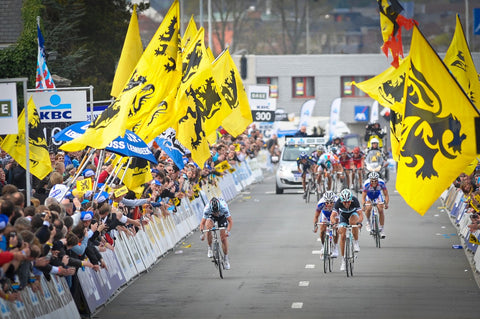
If you never heard of the Flag of Brabant, you have definitely seen it as it is probably the most known flag associated to Belgian cycling! It was a golden or yellow lion climbing the hoist and was displayed on a black surface. The tongue and nails of the lion were red. It also featured the arms of the Kingdom of Belgium.

It wasn’t until 1815 that the Netherlands and Belgium were united to form one country, ruled by King William I. The king was passionately devoted to the preservation of a single state (beneficial to the Belgians) but he was also a Protestant king and the Liberals and Catholics of Belgium demanded more freedom.
The Netherlands slowly began to rule over Belgium while Belgian citizens fought for freedom under a flag with horizontal rather than vertical bands. These colours became their symbol of freedom and independence.
It wasn’t until September 1830 that King William’s troops were expelled from Belgium and a month later Belgium finally became a separate country from the Netherlands.
In the same year, a congress was elected to design a new flag. In a sign of freedom, they kept the same colours but used a vertical striped pattern. This new flag became the official Flag of Belgium in January 1831 and it is still standing.

New and old flags of Belgium. The first one is the one currently in use, the second one with horizontal stripes is the first tricolour Belgian flag from 1830.
The flag in cycling…
How was the national flag adopted in cycling?
Cycling in Belgium goes back a very long way, and we would need a separate article to talk in depth about the history of cycling in Belgium. The Royal Belgian Cycling Association was formed in 1889 and soon after cycling became one of Belgium’s national sports.
The first Belgian Cycling National Championship was held in 1894 (women’s race in 1959) and was won by Leon Houa (also known for winning the first 3 editions of Liège-Bastogne-Liège). We don’t know exactly when the first Belgian jersey was used for the winner, but we do know that since the early days a symbolic jersey was awarded to the winner of the race. The jersey known in Dutch as the driekleur trikot is an emblematic cycling jersey awarded to the winner of the road race, time trial race and also cyclo-cross race.

The road race champion can wear it in any race except races rode as a national team and time trials. The time trial winner can only wear it in time trial stages. Neither would be worn if the rider is a leader of a classification in stage races.
The jersey design reflects the Belgian national flag and has a black upper, a gold centre band and a red lower section.
Up to here it all seems clear, but where does the Belgian blue used by the national team come from?
Confusion starts…
Well, to be completely honest, no one really knows. In fact, there are several theories and we have dug deep in history to find out but there are no 100% certain facts. The most safe theory is the one associated to the Alcyon motorcycle brand (reference thebelgiancyclingjersey.com).
Alcyon was a French motorcycle manufacturer that, since the early years of cycling, played a vital role in sponsoring teams and the best Belgian riders.

Alcyon motorcycle (1933) in Belgian light blue
We have some documentation of early Alcyon motorcycles painted in light blue and we also know for a fact that bicycles were back then (early 1900s) made by or named after their sponsor. So the Alcyon cycling team used to ride light blue Alcyon-branded bicycles and the first Tour de France Belgian winner (Odiel Defraeye, 1912) won on a light blue Alcyon bike.
Did the Alcyon team have a main influence over the light blue used by the Belgian national cycling team? We don’t know. The brand does not exist anymore since the ’60s (it slowly died after it was bought by Peugeot), but their light blue lives on in the national team jersey.

Alcyon bicycle (1910)... maybe the first Belgian blue bike?
Do you think it had an impact on it? In all honesty, all we know is that we love the Belgian national blue jersey and we don’t really care where it comes from! It is part of our history and that can’t be changed.
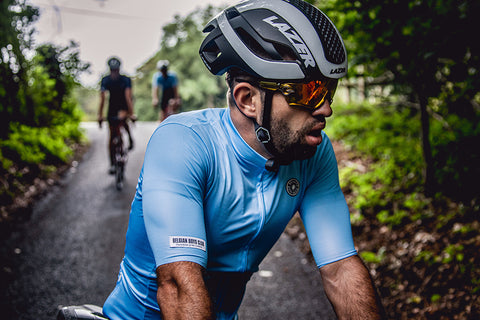
The important thing is that what you wear on your bike should inspire you and truly attest to your cycling passion. Wearing a Belgian jersey means that you will feel stronger, fitter and, last but not least, it will make you turn some heads. The Belgian Crew (aka Belgian Boys Club) is not like any other brand, we are unique and committed. Joining our crew means you love cycling, and everything associated to it. We will not ‘grow your balls’, but we will make you feel Tom Boonen and look cool!
Join the Belgian Crew, possibly in light blue!